-
-
Why I think quest-based systems in MMORPGs suck
7th July, 2014 by ckxComment (1)
MMORPGs were, for a long time, my favorite genre. The only thing more appealing than a good RPG, was a good RPG with the dialogue swapped out for multiplayer mechanics. Even today, I find it to be an amazingly cool concept. I was completely taken by games like Ragnarok Online (RO), Lineage II, Final Fantasy XI, Dark Age of Camelot, and Ultima Online. Naturally, I identified myself as a heavy MMORPG player. That’s no longer the case.
It seems that one day, all MMORPG designers woke up, and collectively had the same thought – “WE NEED QUESTS!“
Regardless of what MMORPG you boot up nowadays, there is a pretty good chance you’re going to find something similar to this in the interface:
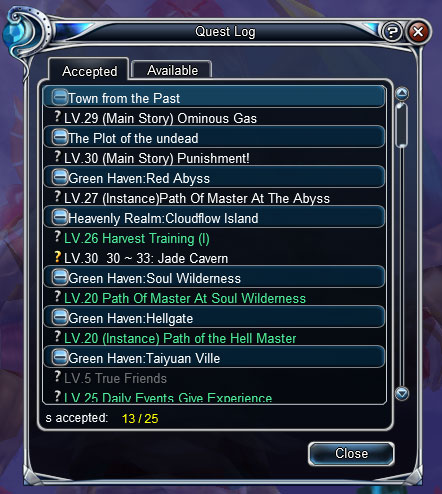
… Horror.
Disclaimer: This article aims to articulate my criticism towards the widespread “quest-based progression style” in today’s MMORPGs. I don’t find quests inherently damaging to an MMORPG, but when they are used as a one-stop shop for streamlined progression/content, exp, gold, etc, things start to get really uninteresting, really fast. Furthermore, I have never played World of Warcraft, and I am fully aware that it both popularized this type of game and it does not succumb to some of the issues I outline below.
Seriously, who cares?
My first criticism of quests in MMORPGs is one so obvious that I almost considered not including it:
Who reads quests?
I acknowledge that loremasters exist, and there are people out there who get really into a game’s world. They are a tiny portion of the population. It’s worth mentioning that I’m not talking about anything like “PvE” players and “PvP” players, I’m talking about people who sit down and actually read the novels worth of text present in MMORPGs. I have tried to do it myself on multiple occasions, but it becomes so overwhelming so quickly, that I inevitably go back to skipping everything I can. In Mabinogi Heroes it was so bad that I made an AutoHotKey script specifically for skipping text. Even if I want to feel invested in the quests, I cannot.
Most people playing MMORPGs are playing in a party environment; commonly with friends they’re on voice chat with, or other players that they’ve met in the game world. This is not the best environment for reading the massive amounts of text present in quest-based MMORPGs. When I say massive amounts of text, I mean MASSIVE. Often times, it’s so bad that you start to think “holy hell I’ve been clicking skip for 15 seconds straight, just give me the freaking quest already.” Then, you have to repeat those steps, doing it all over again… three more times per NPC. In a town with six different quest NPCs.
Why is this in a multiplayer game? The vast majority of players just skip all of the text so that they can play the game with their party members again. The people writing and translating these scenarios are wasting their effort, it’s a minuscule portion of the population that actually pays attention to the text. Your game should absolutely never reach a point where players start saying “I don’t care about any of this, I won’t read it”, particularly on their first time experiencing content. But it’s so natural and widely accepted in MMORPGs, people don’t even seem to think it’s a problem anymore. It’s expected.
Convolution
To make matters worse, the game format of MMORPGs does not lend itself to this method of storytelling. You have a persistent world that a single player’s actions cannot directly change. After all, if a single player could impact their persistent surroundings, other players would be unable to experience the same quests. Because of this restriction, it’s impossible to convey any real meaning that the story may have, as nothing has any real implications for your gameplay.
One way game designers attempt to get around this is by making “instances”, which allow a party to be isolated from the main persistent world. They now have their own world to play in, with a few of the aforementioned restrictions removed. While the events in an instance are still largely irrelevant to the main persistent world, at least now you can have NPCs move around, interact, and often times, die.
But this is stupid. In the single genre of games that allows for interaction with players in a free and large-scale way, a common game design technique exists to remove that appealing aspect entirely, and instead block off your party from the main world. Why? So that you can watch some events that you’ve no attachment or investment in. Wait, what? It’s really that nonsensical. How did things unfold this way and why is it so widely accepted?
Most MMORPGs seem to be trying their hand at an AAA-style dramatic story. But the format is clearly not built for this, and the entire experience becomes a convoluted mess. For example, in Guild Wars there are many reoccurring NPCs, cutscenes with flashy scenarios like large-scale battles, and a generally rich storyline expressed through text and watching actions unfold. However, the large majority of players have no investment in any of this, and instead are focused more on obtaining gear and titles. The most popular character is by far the fairly irrelevant Gwen, just because people find her cute.
MMORPGs can have stories and interesting worlds to them, but why should that be the main focus of the game and executed in such an unsuitable way? The issue becomes even more perplexing when you consider that this is the perfect format for players to build their own stories.
It’s unnatural
The standard MMORPG format (lots of players, large persistent open world) lends itself beautifully to creating interesting social relations between people. Friends or like-minded people will band together and create guilds. Using guilds, people have a pool of players that they interact with regularly. If you didn’t have preexisting relationships with your guild members, you generally get to know them pretty quickly, especially if you start partying together.
Since guilds are a part of the persistent world, you start to see the same guild names over and over again. Thus, players in a party from one guild will start interacting with a party from another guild. Now, inter-guild relationships start forming – alliances, rivalries. If you happen to get along with a certain guild, you can band together and defeat world bosses or form a PvP-based alliance. On the other hand, if you find the other players a bother, you can begin wrecking their leveling efficiency and establish a rivalry in both leveling and any PvP events that may occur.
As guilds start becoming familiar to you, so do the players within them. You’ll be able to pick out the names of core members from certain guilds. This is where the larger story in many MMORPGs begins to form, and it’s very anecdotal (if you’ve ever read stories about EVE Online, you know). But more importantly, the familiarity involved with a persistent world gives you your own stories: “I’ve partied with that priest before, she doesn’t have resurrection, let’s not invite her.” “We’ve been keeping track and «Ketsumei Kishidan» has killed 16 Valkyrie spawns… they’ll have more valk armors in this week’s PvP.”
That’s interesting, and that’s natural.
This sort of thing exists vaguely in most quest-based games, but it takes a back seat in your experience, with reading lots of irrelevant dialogue boxes at the front. While guilds still exist and players can still learn familiar names, high level partying often happens inside of instances, which removes a lot of the anecdotal nature of your story unfolding… and since guilds are often only exposed to their own guild members, that means inter-guild relationships aren’t as strong. While it’s possible to form these sorts of relationships inside of the confines of a quest-based system, that system is rarely adding anything to the experience, and at it’s worst, it’s preventing such interactions from occurring at all.
MMORPGs should ideally be about how you as a player experience the world, and about how you interact with other players, and what that means to you. Doing this in a free way means that your interactions in the game world closely mimic how interacting in the real world works. No, I’m not trying to say there’s some social commentary or great reflection on who you are involved, but rather that the “story” of the game becomes your memories within the game world, and your relationships that form from the events that happen naturally in the world. That’s what a person’s life story is, and that’s what an interesting MMORPG story is.
Furthermore, as we all know, being told why you should care about something is bad game design. Players should be self-motivated in their actions – this a fundamental concept in having fun. Quest-based games take that part of that away from players, and their own experiences take a back seat to the main pre-determined events that they’re playing through. Rather than genuinely caring about the game they are playing, most players are motivated by becoming stronger solely due to the immediate social implications.
World tour
Perhaps the greatest sin that this design style commits is in its progression style.
In a typical non-quest based MMORPG, you are dropped in the world and told some basics. From there, you figure everything out on your own. Whether that means personal experimentation, research, or a combination of the two… it’s up to you. The point is, hand holding ends extremely early, and you are able to experience the game first-hand.
If you find a spot that you enjoy leveling in, you may do so. If you wish to try out different areas and level on more varied enemies, you may do that too. But ultimately it is your responsibility to learn the world. The great part about that is, you won’t even realize it’s happening. As you branch out from town, you’ll usually find some easy monsters in the surrounding areas, then defeat them to start getting your bearings. From there you can keep going forward and find new enemies to start obliterating. Eventually you’ll go far enough away from town, or get curious enough about a specific dungeon, to wander into high-level areas. But once you die, you respawn in town, no big deal. But with this simple sequence alone you’ve learned a lot about the game world, and the game didn’t have to hold your hand or tell you what to do.
With some more experimentation, you may find a better spot to play in. Or perhaps someone else with more knowledge will give you a recommendation on what to do and where to go. But it’s just that – a recommendation.
In a quest-based game, this freedom of choice is forcefully removed from you. Not just in where you go, but how you get there, why you go there, and what you do when you arrive. You’re playing the exact same sequence that tens of thousands, maybe even millions of people, have already gone through. There is nothing “game-like” about this. You may be given the illusion of having a unique experience through various mechanics, but ultimately you are executing a sequence of actions in a predetermined order, not unlike the code being processed under the game’s hood. Your own actions, your own little “variables”, are completely meaningless in the big picture.
Worse yet, the game world becomes hollow and meaningless to you. You’re taken on a tour from quest hub to quest hub, and you’re shown some pretty graphics along the way, but there’s nothing to set these areas truly apart or giving them unique meaning in the gameplay sense. After you clear the “level 5-10 area” and the “15-19 area”, you seldom have reason to ever step foot back there. Once again, one of MMORPG’s greatest assets, its gigantic world, is largely trivialized and reduced to what is little more than standard arcade-game stages.
If you do manage to break free from your chains and experiment with the game world, say by progressing to new areas before the game puts an arrow in your face telling you where they are, then you will often be shut down in various different ways. In TERA, if you manage to kill a monster with a substantially higher level than you, your obtained EXP will actually be nerfed to 0! How ridiculous is that? In a game with an action combat system where you’re able to dodge attacks and stay alive with well-timed execution and clever strategies, too.
Completing any content in higher level areas is often worthless. Quest hand holding doesn’t stop at EXP either – even leveling gear is often determined by what quest you’ve completed. This means that new sets of gear come in waves after you hit certain levels, and if you explore higher level areas, you simply can’t use anything you find there due to being too low level. Or, maybe it’ll just be a hard number game and you’re shut down by a lack of attack to break through a monster’s defense, so you can’t kill anything there anyways. Regardless, there always seem to be plenty of roadblocks in place that completely destroy what originally made MMORPGs interesting.
On the flip side, I could not count the number of viable ways to level up in a more open game like Ragnarok Online. There are just too many. If you feel like you’ve got the skills required to kill high level monsters as a low-level character, go for it. If you manage to do it, you don’t get nerfed EXP, you’re rewarded with 3 levels off of one kill. If you get the idea to use class-neutral resurrect items on high level undead monsters when you’re only level 1 – hey, it might take you a few tries, but it’ll work.
Imagine that, players have to think for themselves to play better.
In a more open game, maps in the world never completely lose their meaning to you either. Being that there are no instances in RO, bosses exist in the open world (*Note: they did shoehorn some irrelevant instances later on in the game’s life). This means if you want to go boss hunting, you take a tour across the world and visit many different types of maps. A similar feeling was crafted by raid boss hunting in Lineage II. To be fair, both of those games have a large number of useless locations, but the point is that the number of relevant locations is also very high.
Furthermore, as there’s no “set progression” for your item or EXP builds, items from all over the game world are useful. It isn’t uncommon for a high-level player to spend a long time in a lowbie map in RO, because they’re looking for a useful card drop or hunting crafting materials.
Normalization of damage based classes
This is a very serious side-effect of “tour progression” in many games, and I feel it does not get enough recognition as an issue among most players. Let’s say a game has nine classes, and five of those classes are primarily based around dealing damage (Damage Dealing class, or ‘DD class’ – recently also known as a ‘DPS class’).
The problem here is that with most quest based systems, everyone has to clear the same content. If everyone has to go through the same content, that content needs to be “normalized” so that all different types of classes are viable. While numbers may dictate that healers and tanks are required, enemies cannot have too many specific properties that tailor to one type of DD class over another, otherwise a major issue in game balance occurs. This means that in every single area, monsters will die to Mage and Priest duo with more or less the same ease as a Sword and Priest duo. Is the problem apparent yet?
Yes, while flashy spell effects are different and properties on attacks may have some slight differences, if every DD class can do every bit of content in a game’s progression, they start to all feel the same. For example, in Rift, it does not matter what combination of rogue, mage, and warriors are in your party; as long as you have a damage dealer that can deal damage, a tank, and a healer, you will be set for the vast majority of instances in the game.
This differs from more open MMORPG design greatly, where developers are allowed to create challenges or maps that could potentially shut down specific classes entirely. At first that may sound like a bad thing, but what it really implies: The classes are truly different.
Not just in playstyle and skills but in viability and utility. This changes not just the ecosystem of classes, where suddenly some DD classes are more useful in certain areas than others, but also how everyone playing the game interacts with those classes. In Ragnarok Online, a typical Priest and Crusader combo may level in Chivarly or Niflheim, but those options would be completely off limits to a Priest and Wizard combo, who would prefer Ice Dungeon or Magma Dungeon.
More than just location, the Priest’s playstyle would differ as well. With a Knight, they may focus on staying back, healing the Knight and debuffing monsters. However, put the same Priest with a Wizard, and they suddenly have an entirely new playstyle presented to them. Now, they are focused on drawing monster aggression to themselves and putting casting buffs on the Wizard.
These type of little differences manifest themselves in ways all over a game and add up to an experience that really sets apart players, classes, and builds.
One more thing
A quick point I want to make – since MMORPGs are largely played with friends or guildmates, and since people have different schedules, quest-based games can be a major pain in the ass if you want to play with a consistent group of people.
Because you typically have to clear quests in a certain order, if your friends are not online, you have to progress ahead of them. Then when they log back on, you’re further along in the chain than they are – so if you party with them, you’re backtracking and essentially wasting your own time, since you aren’t receiving quest rewards. It gets especially bad if someone cannot play for a few days at a time, or if they want to make a new class… a large list of other problems arise that ultimately boil down to logistics killing fun.
Did I mention that managing 20 different quests, each to collect some random item or kill 10 monsters, is unfun and stupid? Because it is. Regarding “quest management”, in most quest-based games there’s a limit on how many quests you can pick up at once (WHY!?), so you have to start dropping ones that you skipped or can’t complete right now… it’s a nonsensical mess of a design that I’ll never fully understand.
Meanwhile, in a more open game, you just kill monsters and don’t worry about managing the massive blobs of text on your UI. This means that, if someone leaves for a week, you can just… keep killing monsters. Then when they return, you can… just kill monsters with them again. Cool, huh?
Conclusion
questing sucks, and i dunno how to end articles
cya
- Posted in:
Comment (1)
-


permlink Aug 10, 06:40 AM
Kim says:
That’s actually quite true. Quests should not be a focus of MMORPG, only a topping when everything is done right.